> ## Documentation Index
> Fetch the complete documentation index at: https://podium.do/docs/llms.txt
> Use this file to discover all available pages before exploring further.
# Create and track issue work
> Describe work, claim it, record progress, add dependencies, and close it.
Use issues for work that needs ownership, isolation, dependencies, or a review trail. Keep the human description short and put implementation constraints in the technical brief.
## Create an issue
Run the command from the target repository so Podium can infer `--repo-path`:
```bash theme={"system"}
podium issue create \
--title "Cache invalidation tests" \
--description "Cover stale entries after a repository rename." \
--brief "Add regression cases without changing the cache contract."
```
Issue and session titles should use three to five words. An operator-created issue starts in backlog unless you pass `--start`. A top-level issue filed by an agent through `podium issue create` starts in proposed.
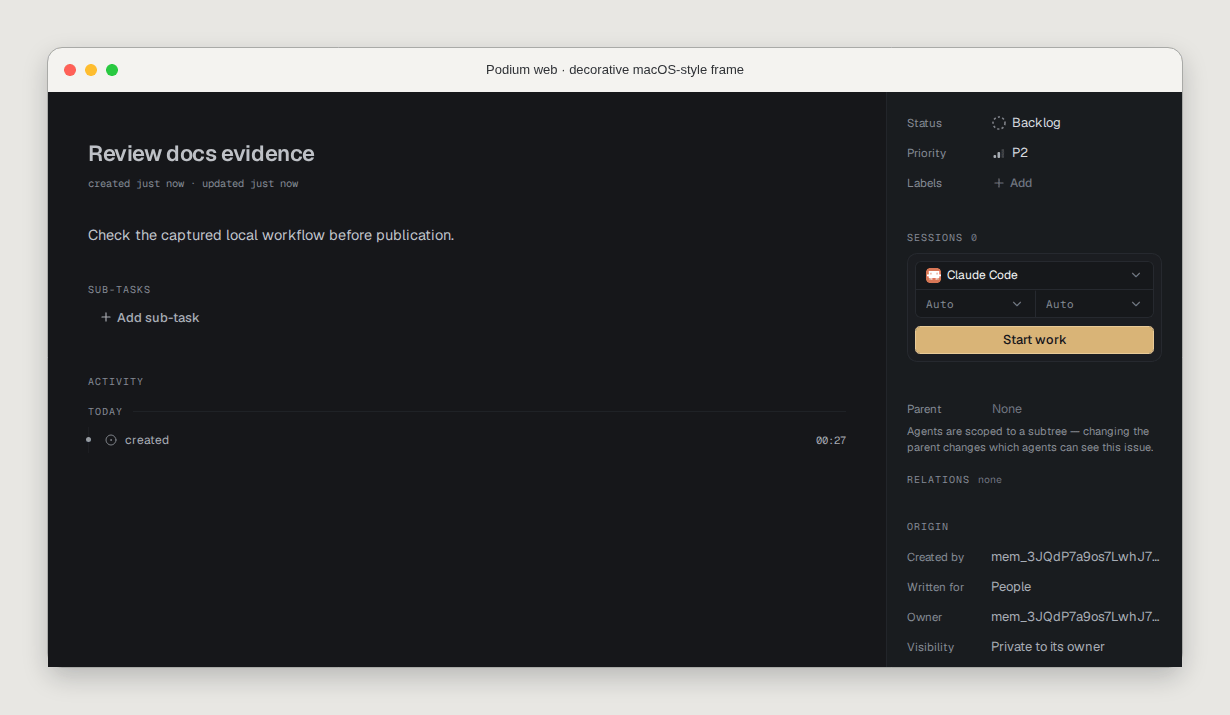 ## Start or claim work
Start an issue to create its branch, worktree, and first agent session:
```bash theme={"system"}
podium issue start your_issue_ref --agent codex
```
Move the issue to planning while you define the approach, then claim it when implementation starts:
```bash theme={"system"}
podium issue update --id your_issue_ref --stage planning
podium issue claim your_issue_ref --assignee me
```
Claiming sets the assignee and moves the issue to `in_progress`.
## Keep the issue readable
State is one current paragraph for the operator. Todos are short, human-facing checkpoints:
```bash theme={"system"}
podium issue state your_issue_ref \
--set "Regression reproduced; adding coverage before changing the cache."
podium issue todo your_issue_ref --add "Add the failing rename case"
podium issue todo your_issue_ref --add "Run the cache test suite"
```
Mark a todo complete by its displayed number:
```bash theme={"system"}
podium issue todo your_issue_ref --done 1
```
## Record dependencies
Add a blocking edge when one issue cannot finish before another:
```bash theme={"system"}
podium issue dep-add dependent_issue_ref blocker_issue_ref --type blocks
```
Use a child issue when the parent cannot ship without that work. Use a separate top-level issue with a `discovered-from` relationship when the current deliverable can ship without it.
If you are moving this session onto the discovered work, create the top-level issue and relationship, then rehome the session in one command:
```bash theme={"system"}
podium issue attach \
--spinoff "Cache telemetry cleanup" \
--confirm-rehome
```
This command rehomes the current session. To file the work for another agent while staying on the current issue, create it without `--start`, then add the relationship in this direction:
```bash theme={"system"}
podium issue create \
--title "Cache telemetry cleanup" \
--description "Remove obsolete cache telemetry in a separate change."
podium issue dep-add new_issue_ref current_issue_ref \
--type discovered-from
```
Top-level work filed with `podium issue create` by an agent while staying on the current issue lands in `proposed`. Do not claim or stage it unless you are assigned to move onto it.
## Inspect and close work
Read the final record before closing it:
```bash theme={"system"}
podium issue show your_issue_ref
podium issue close your_issue_ref --reason done
```
Close only after the requested outcome is accepted or no longer required. A hibernated session does not close its issue.
## Start or claim work
Start an issue to create its branch, worktree, and first agent session:
```bash theme={"system"}
podium issue start your_issue_ref --agent codex
```
Move the issue to planning while you define the approach, then claim it when implementation starts:
```bash theme={"system"}
podium issue update --id your_issue_ref --stage planning
podium issue claim your_issue_ref --assignee me
```
Claiming sets the assignee and moves the issue to `in_progress`.
## Keep the issue readable
State is one current paragraph for the operator. Todos are short, human-facing checkpoints:
```bash theme={"system"}
podium issue state your_issue_ref \
--set "Regression reproduced; adding coverage before changing the cache."
podium issue todo your_issue_ref --add "Add the failing rename case"
podium issue todo your_issue_ref --add "Run the cache test suite"
```
Mark a todo complete by its displayed number:
```bash theme={"system"}
podium issue todo your_issue_ref --done 1
```
## Record dependencies
Add a blocking edge when one issue cannot finish before another:
```bash theme={"system"}
podium issue dep-add dependent_issue_ref blocker_issue_ref --type blocks
```
Use a child issue when the parent cannot ship without that work. Use a separate top-level issue with a `discovered-from` relationship when the current deliverable can ship without it.
If you are moving this session onto the discovered work, create the top-level issue and relationship, then rehome the session in one command:
```bash theme={"system"}
podium issue attach \
--spinoff "Cache telemetry cleanup" \
--confirm-rehome
```
This command rehomes the current session. To file the work for another agent while staying on the current issue, create it without `--start`, then add the relationship in this direction:
```bash theme={"system"}
podium issue create \
--title "Cache telemetry cleanup" \
--description "Remove obsolete cache telemetry in a separate change."
podium issue dep-add new_issue_ref current_issue_ref \
--type discovered-from
```
Top-level work filed with `podium issue create` by an agent while staying on the current issue lands in `proposed`. Do not claim or stage it unless you are assigned to move onto it.
## Inspect and close work
Read the final record before closing it:
```bash theme={"system"}
podium issue show your_issue_ref
podium issue close your_issue_ref --reason done
```
Close only after the requested outcome is accepted or no longer required. A hibernated session does not close its issue.